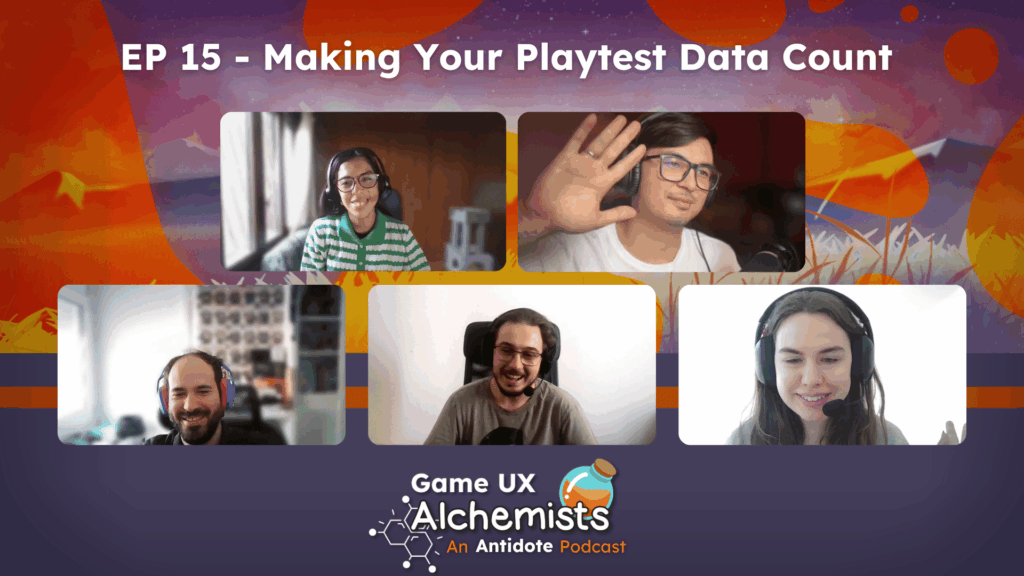

Watch the full video where our UX Lead, Joan Costa, walks through how we structure interviews & focus groups at Antidote!
What Are Interviews and Focus Groups?
Interviews and focus groups are qualitative research methods that let you gather in-depth information beyond what surveys can capture. The key advantage is flexibility because you have a script with prepared questions, but you can adjust on the fly based on what players say.
If someone mentions they dislike a character, you can immediately ask why. Is it the visuals, the dialogue, the gameplay mechanics? This back-and-forth reveals the reasoning behind player opinions, not just the opinions themselves.
Interviews vs. Focus Groups
One-on-One Interviews
Interviews are individual conversations between a moderator and one participant. This format creates a comfortable environment where players often feel more freedom to share honest opinions without group dynamics influencing their responses.
Players who might feel shy in group settings tend to open up more in one-on-one scenarios. The moderator has full control over the conversation flow, making it easier to explore specific topics in depth.
Typical Duration: 45-60 minutes per participant
Focus Groups
Focus groups bring together 6-8 participants for facilitated group discussions. The goal is to observe how players discuss, debate and potentially reach consensus or disagreement on game elements.
You might pose a question and let participants discuss among themselves. Some might love a feature while others dislike it, watching them articulate their arguments reveals why certain elements work or don’t work for different player types.
Why we recommend 6-8 participants? This size allows active conversation without losing control. Too few and you don’t get diverse perspectives. Too many and you can’t ensure everyone participates or track all the input effectively.
The Moderator’s Role in Focus Groups
Different personality types emerge in groups, where some participants are naturally vocal, others are quieter and more reserved. The moderator creates a safe environment where everyone can share while preventing any single person from dominating the conversation.
You need to actively invite quieter participants to contribute while gently redirecting overly talkative ones. If you wanted only individual opinions, you’d conduct interviews. Focus groups exist specifically for that group dynamic and discussion.
How We Structure These Projects
Planning and Client Involvement
We schedule sessions with recruited players who match your target profiles. Sessions can be moderated by our team or include your development team for their game-specific knowledge.
Having developers join moderation can be valuable. While our team brings UX research expertise, how to ask questions, avoid bias, facilitate discussion etc., we haven’t spent months or years creating the game. Developers have deep knowledge of design decisions, intended player experiences, and specific systems, which means they can ask specific follow-up questions. The combination of research methodology expertise and game-specific knowledge often produces the strongest insights.
Two-Part Studies
Many projects combine gameplay sessions with follow-up interviews or focus groups:
- Players complete a playtest session
- We review results and identify areas needing deeper exploration
- We adapt the interview/focus group script based on initial findings
- We conduct conversations to understand the “why” behind the data
This connects quantitative patterns from playtests with qualitative insights from conversations.
Common Applications
Studios typically choose interviews and focus groups when they need to understand player motivations and reasoning in areas like:
1) Character and Narrative Feedback: Understanding why players connect with or dislike specific characters or story elements
2) Visual and Art Direction: Exploring player perceptions of art styles, character designs, and overall visual presentation
3) Cultural Localization: Testing how game elements are perceived across different regions to ensure cultural appropriateness
4) Post-Survey Deep Dives: Following up on surprising or unclear survey results to understand the reasoning behind the numbers
Real-Life Applications
Due to confidentiality agreements, we can’t name specific games, but we can share how these studies were structured and their impact.
1) Idle Mobile Game Character Study
Challenge: The studio needed to understand player feelings about characters, visuals, and mechanics, particularly whether visual design matched the mechanics being offered.
Our Approach: Two-part study with playtest sessions followed by 45-60 minute individual interviews. We adapted scripts based on initial gameplay findings.
Results: Clear insights into whether visual presentation aligned with player expectations. Identified specific mismatches where art style didn’t communicate what the mechanics delivered.
2) Cross-Regional Localization Focus Groups
Challenge: The studio wanted to ensure their game was culturally appropriate across different regions without inadvertently offending any culture.
Our Approach: Organized separate focus groups per country/region, presenting game materials and facilitating discussions about cultural perception.
Results: The studio identified elements that worked universally and others needing regional adjustment or removal, successfully adapting the game for global audiences.
3) F2P Mobile Game Mechanics Deep Dive
Challenge: Initial survey data (150+ responses) showed certain mechanics and maps performed poorly, but the studio needed to understand why.
Our Approach: Started with broad surveys, then conducted focus groups targeting specific problem areas identified in the data.
Results: Detailed understanding of why specific elements weren’t working. The studio made targeted improvements, then revalidated with follow-up surveys to confirm changes worked.
Need Help Organizing Interviews & Focus Groups?
If survey data shows problems but doesn’t explain why, or if you need to understand the reasoning behind player preferences and behaviors, interviews and focus groups provide the depth that quantitative methods can’t capture.
At Antidote, we’ve organized countless interview and focus group studies across every game genre. If you need help uncovering the “why” behind player feedback, contact us to discuss your qualitative research needs.