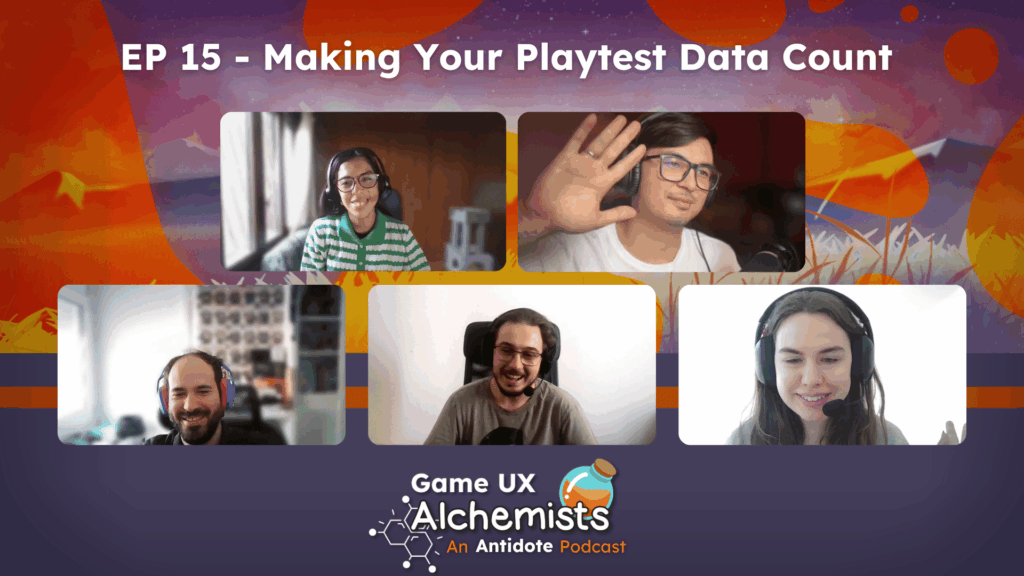

Watch the full episode: How Different Backgrounds Shape UX Research (Game UX Alchemists Podcast)
Every researcher brings something different to the table. And in this episode of Game UX Alchemists, we explored how those differences actually shape the way UX research is done at Antidote.
It was a more personal, reflective episode where Joan, Lucy and Victoria sat down to talk about their career paths and how their diverse backgrounds influence how they work today.
Here’s the quick summary. Enjoy the read 👇
Team Member Stories
Joan
Background: Game Development & Computer Science → Banking UX → Gaming UX
- Started with game development and design, focusing on coding
- Discovered UX through playtesting and player behavior analysis during studies
- Spent 2 years in banking UX
- Additional experience: Basketball coach for kids aged 6-8
- Key Skills Transferred: Technical problem-solving, age-appropriate communication, understanding implementation complexity
Vicky
Background: Media Arts → Technical Support → Gaming UX Research
- Studied media arts, learning video production, coding and game development
- First gaming industry role: technical support for mobile games
- Directly communicated with players via email ticketing system
- Had access to player logs and behavioral data
- Key Skills Transferred: Patience with frustrated users, empathy, understanding player psychology, technical troubleshooting
Lucy
Background: Hotel Management → Customer Service → UX Research
- Studied hotel management in Buenos Aires, Argentina
- Worked 4 years as a hotel receptionist in London
- Learned UX through courses and case studies
- Key Skills Transferred: Customer-first mentality, active listening, empathy, reading nonverbal cues, problem-solving under pressure
How Different Backgrounds Shape the Way We Work
After hearing everyone’s stories, the conversation shifted into how those backgrounds shape the way research is done at Antidote.
The difference shows up everywhere. How we frame interview questions, how we analyze free-text responses and how we prioritize feedback in reports. Some team members are quick to pick up on emotional nuance in what a player says (or doesn’t say). Others are laser-focused on spotting data trends, patterns or contradictions.
And that’s exactly the point.
At Antidote, we don’t believe there’s just one “right” way to do research. Having a team that combines analytical thinkers, empathetic communicators and sharp problem-solvers means we catch more angles and deliver richer insights to game studios.
That variety also keeps things grounded, to make sure our findings actually help devs build better games.
Intuition vs. Structure
One of the most interesting parts of the episode was the discussion around research intuition versus structure. It’s a balancing act that the whole team has had to learn.
Lucy mentioned how, during moderated playtests, some of the most revealing moments don’t come from what players say. But from how they act, what they hesitate on or what makes them smile. That kind of insight doesn’t show up in survey responses, but it’s just as valuable.
Victoria added that coming from a non-academic path helped her trust her instincts, especially when analyzing feedback that doesn’t fit into neat categories. Having spent so much time talking to players directly, she knows when something “feels off”, even if it’s not immediately measurable.
Joan, on the other hand, brought in the need for frameworks and consistency. Especially when dealing with multiple stakeholders or fast-moving projects, having structured approaches keeps the team aligned and makes the insights repeatable.
So how do we reconcile these differences?
The takeaway was clear: good UX research lives between the two worlds. You need enough structure to stay grounded, but enough flexibility to let human insight shine through.
At Antidote, that mix is intentional. We actively rely on both instinct and data, gut feeling and evidence. Because we acknowledge that the games are playtested by real people. And people are messy, emotional, curious and inconsistent.
Our job is to meet them where they are and design research that does the same.
Final Thoughts
Not every UX team looks the same and that’s a good thing.
The different paths our researchers took (from hotel front desks to game dev classrooms) all come together to create better, faster and more human research.
We hope you enjoyed this episode’s recap and got to know more about our team’s stories. Stay tuned for the next one 😊