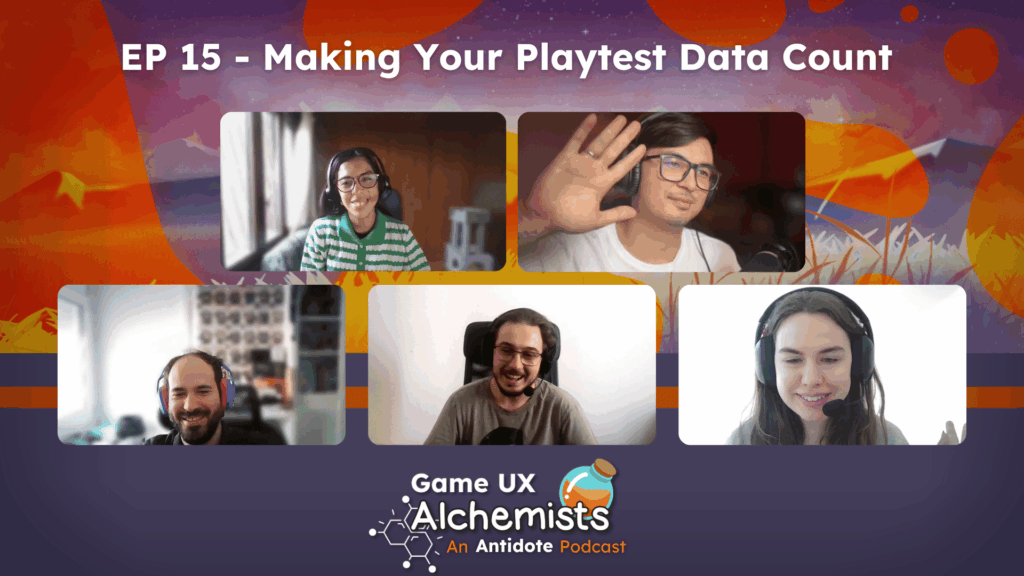

Watch the full video where Robin Schreurs and Makenzie Kingston explain how we organize large-scale tests at Antidote
What is a Large-Scale Test?
A large-scale test means recruiting a large pool of players (often several thousand) to take part in a test at the same time. Unlike the regular playtest, these tests are built around volume and in most cases, fall under one of three goals:
- stress testing your servers
- running a closed alpha with a specific audience
- measuring player retention over several days or weeks
We’ll walk through all three in the next section 😁
Why Should You Run a Large-Scale Test?
1) Stress Test Before Launch
If your game is built to handle thousands of concurrent players, stress testing is the only reliable way to confirm your servers and engine can actually handle that load. Running the test before launch means any issues get caught and fixed while there’s still time, instead of surfacing in front of real players on day one.
2) Reach a Specific Audience
Closed alphas let you recruit the exact kind of player your game needs feedback from, rather than a general crowd. That could mean players who like shooters broadly or something narrower, like players who specifically play extraction shooters. We can also build in a control group, players who don’t play your genre at all, to see if your game has crossover appeal.
3) Understand Player Retention
A test that runs over several days shows you what a single-session playtest can’t. For example, how many players come back on day two, how many drop off after day one and why. Combined with surveys and incentives, retention tests give you real signal on what’s keeping players engaged or pushing them away.
4) Build Community and Hype Pre-Launch
Because large-scale tests run through channels like Discord, they double as an engagement tool. Players get hyped, talk to each other and become early advocates, all while your team gathers the data it needs.
What We Track
Beyond the core playtest data your team is after, we keep tabs on a few things throughout the process:
1) Cohort composition
if your test needs 20% of one player type and 40% of another, we track recruitment against those targets in real time and adjust campaigns accordingly.
2) Forecasted vs. actual turnout
not everyone who signs up claims a key and shows up to play, so we track redemption and no-show rates to make sure the final numbers land where you need them.
3) Community sentiment
our moderation team keeps an eye on how the conversation is developing inside Discord, since narratives around a game can shift quickly in either direction.
4) NDA compliance
for confidential builds, we actively monitor platforms like Twitch and streaming/forum spaces for unauthorized sharing.
How Antidote Organizes a Large-Scale Test

Step 1: Briefing and Scoping
We start by understanding your technical setup, your target audience and what you’re hoping to learn. This is also when we sort out any technical or backend details on your end that haven’t been fully mapped out yet and where we ask for materials, like a trailer or key visuals, that we can use to recruit players.
Step 2: Recruitment
We recruit players through two avenues. First, from our worldwide panel of players already in our community. Then, when the test needs a bigger or more specific pool, we run campaigns across platforms like Instagram, YouTube, Reddit and TikTok, choosing channels based on where your specific audience spends time.
For larger or more confidential projects, we’ve also worked with influencers and streamers directly. Players who click through land on a subdomain landing page we host on your behalf, so the experience feels native to your brand.
Step 3: Screening and Cohort Building
Every test gets a custom screener designed to sort players into the right categories. If your test needs multiple player profiles at specific ratios or a control group outside your usual audience, the screener handles that sorting automatically. All of this is GDPR compliant, and where relevant, we can pull in verification through platforms like Steam or Xbox to confirm playtime without asking players for manual proof.
Step 4: Onboarding
Screened players move into a Discord server built specifically for your test, with its own roles, permissions and channels. We handle NDA distribution, key delivery and a bespoke email campaign using your branding. The goal throughout is to remove friction:, so fewer steps, fewer repeated questions and a clear path from signup to the actual test.
Step 5: Test Day Moderation
Once the test is live, our moderators are on hand in Discord to answer questions, keep the chat clean and manage behavior in real time. Some clients prefer to run moderation themselves and we’re glad to step back where that’s the case.
Step 6: Wrap-Up
After the test, we handle post-test communication, including any giveaway or reward logistics and can share recruitment and engagement data back to your team.
Real-Life Applications
Due to confidentiality agreements we can’t name specific games, but here are some real examples of how lab tests have run.
1) Shooter Playtest with a Genre-Outsider Control Group
Challenge: The client wanted feedback from their core shooter audience, but also wanted to know whether the game could appeal beyond typical shooter fans.
Approach:
- Built a screener targeting several shooter sub-types at set ratios, roughly 20% one profile, 40% another, and a smaller Battle Royale segment
- Added a dedicated control cohort, around 10% of the total, made up of players who don’t normally play shooters at all
- Tagged and tracked each cohort separately throughout recruitment so results could be compared side by side
Results: The client got a clear read on how their core audience responded, plus a genuine signal on whether the game could pull in players outside the genre, insight they wouldn’t have gotten from a standard recruitment pool.
2) Timing-Sensitive UK Recruitment Campaign
Challenge: The client needed exactly 400 UK-based testers on a fixed date that happened to fall the day after a major national holiday, a timing detail that could swing turnout in either direction.
Approach:
- Forecasted expected redemption and no-show rates based on past campaigns and the specific date in question
- Factored in regional habits and holiday behavior to estimate whether turnout would run higher or lower than usual
- Adjusted total recruitment numbers upward to guarantee the client’s 400-player target regardless of how the holiday affected attendance
Results: The client hit their target headcount on the day, without over- or under-recruiting significantly, despite the tricky timing.