
Two months before Half-Life was scheduled to ship, Valve realized they had a massive problem.
Their game just wasn’t good enough.
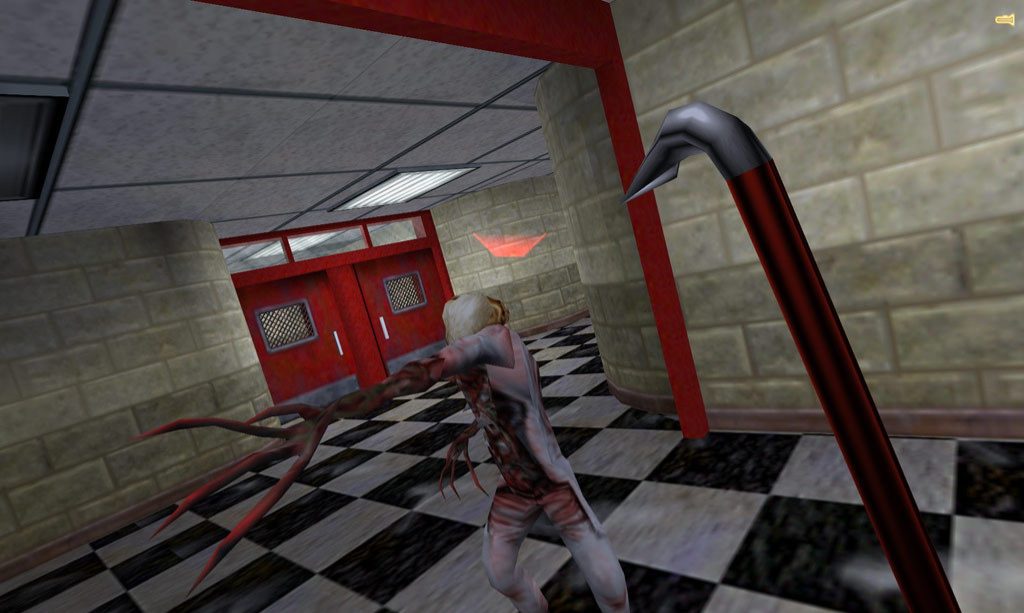
When the developers finally stitched all the levels together and played through the campaign from start to finish, the flaws immediately stood out. The flow felt clunky, the progression made little sense and the fun factor wasn’t there. Rather than shipping a mediocre title to meet a deadline, Valve made a radical call by scrapping almost everything.
As designer Ken Birdwell later put it, the team essentially “threw out just about everything”, gutting level layouts and starting over.
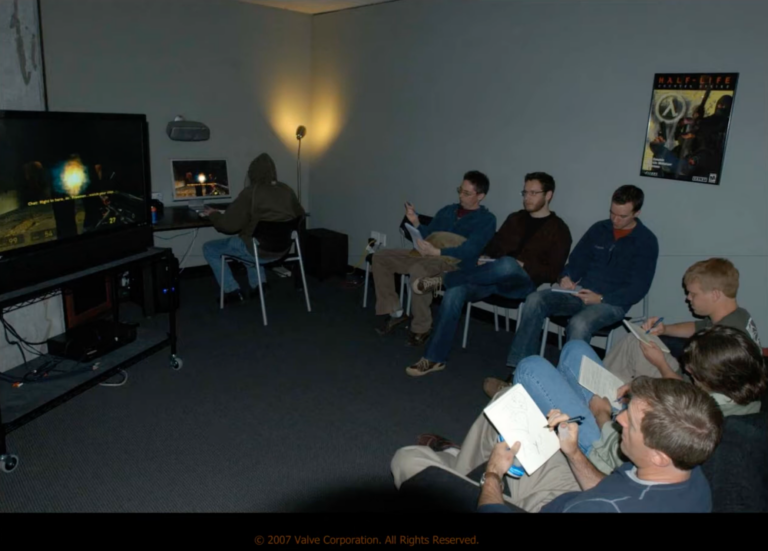
A photo from an early 2000s playtest of an in-development Half-Life 2
To rebuild from scratch, Valve created a dedicated cross-disciplinary group called the Cabal. It was a team of engineers, level designers, writers and animators who met six hours a day, four days a week, for six months straight to design one coherent experience.
Alongside the Cabal, Valve brought in their publisher, Sierra, to recruit local playtesters from nearby game stores and product-registration cards. A tester would sit down for a 2-hour session while Valve staff sat silently behind them, taking relentless notes. Every time a player got lost, confused, frustrated or bored, that moment became a concrete item to fix.
That single experience locked in Valve’s culture forever. Today, they are famously obsessed with playtesting.
The Loop: Goal, Design, Test, Repeat
Every game studio playtests, but Valve takes the process to an extreme level. They treat game design almost like a scientific experiment split into a strict four-step loop:
- Set a clear goal: Decide exactly what feeling or mechanic a level needs to teach the player.
- Build a simple test: Create a bare-bones graybox environment designed solely to test that idea.
- Evaluate with real players: Watch playtesters interact with the space without giving them any hints.
- Iterate or throw it out: If players get frustrated or miss the point, redesign it and run the test again.
Kim Swift, lead designer of Portal, said Valve began playtesting the game in its first week of development, even when the team had only one unfinished room to show. She explained that Valve tried to build testable levels quickly: “in two to five days we’ll have it up and running,” then bring in someone to experience it for the first time.
During Portal’s development, Valve ran playtests nearly every week. Swift later said, “Playtesting is probably the most important thing we did on Portal,” adding that the team’s core method was simply to “sit down and watch people play your game.”
This loop mattered because players often reveal problems designers cannot see. A mechanic may make sense to its creator but fail completely when a new player encounters it without context.
How Playtesters Shaped Valve’s Most Iconic Features
Some of the coolest mechanics in gaming history came directly out of watching playtesters struggle or smile. Here are some examples:
- Portal’s clean aesthetic: Early builds of Portal looked like a gritty, run-down industrial facility. Playtesters found it depressing and visually confusing, which forced Valve to shift to the iconic, sterile white laboratory look that defined the final game.
- The Gravity Gun in Half-Life 2: Valve originally planned to give players the Zero Point Energy Field Manipulator near the very end of the game. But after watching playtesters lose their minds with joy while slinging barrels around, they moved the weapon much earlier into the story.
- Outline highlights in Left 4 Dead: In early playtests of Left 4 Dead, players constantly lost track of their teammates in the dark during chaotic zombie hordes. Adding wall-hack style X-ray outlines through walls solved the issue overnight, keeping the focus entirely on team cooperation.
Valve treats playtesters like part of the design team. If a player gets confused, the level layout gets fixed. If they miss a key clue, the visual feedback gets tweaked.
Instead of relying on pure instinct, Valve builds their games through ruthless iteration. They test an idea, observe what real players actually do, and scrap whatever doesn’t work. It takes time and discipline, but it’s how they consistently ship masterpieces.